
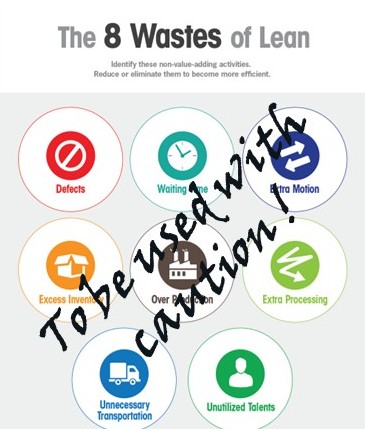
We love to talk about ”going to GEMBA” and ”observing waste on GEMBA Walks” but in reality we often don’t know what to look for.
”But we have the 8 Wastes depicted on the poster on the wall” you say – so what can possibly go wrong ?
Ever thought about what customers are willing to pay for ?:
•Transport from logistics companies and TAXI drivers
•Waiting time – the lifeguard at the swim, call centre for emergency calls
•Quality checks – in airports and pharma industry
•Inventory – renting a storage room for your private stuff
•…… Did I forget any ?
The 8 Wastes as we have come to know them by heart originate from manufacturing industry where it is often easy to separate tasks that adds value to the product from non-value adding tasks. But waste in many industries like service industries, IT, administrative task in virtual systems etc. are more difficult to define and observe.
So the guy waiting or transporting stuff may not be waste, but actually doing value add activities that the customer is willing to pay for.
The original definition of waste (muda): “any activity that consumes time, resources, or space but does not add value to the end-customer” is worth remembering here because that’s what we should look for, and this is what was simplified in the original 7 defined waste types for that specific industry.
But defining the waste activities for YOUR company will require that:
•You know in detail what creates value for your end-customer
•You know in detail the standard operating procedure for the activity you observe
•You have visuals in place so you can see if the actual activity is according to the standard
–and any discrepancy to this will be waste.
So don’t just grab the 8 Wastes poster on the wall for your GEMBA walk – you need to do your homework instead.